Thursday, July 21, 2011

Enda Kenny: "This is a Republic, not the Vatican."

Enda Kenny, Taoiseach (Premier) of Ireland, has just strapped on a massive pair of balls. For the first time in the history of the Irish State, one that has been ravaged by the control, hypocrisy and sex crimes against children by representatives of the Church for decades, the leader of the Irish State has irrevocably slaughtered, denied and criticized the Vatican (The Holy See) in its role, response and attitude to the rape and torture of children in Ireland by its Clergy.

Enda Kenny, Taoiseach of Ireland.
I have been dipping in and out of the revelations of the Cloyne Report and my initial response was to think: here we go, another sex abuse scandal with the Church that I wasn't prepared to expose myself to. I thought that nothing of value would ever come from it, that those victimized and abused would never be recognized fully or have their shattered lives restored. I was wrong. For the first time ever, Ireland's leaders have responded with strength, authority and conviction in facing the  self righteous and elitist attitude of the Church towards the abuse of children carried out by its representatives. Not only that, but the Vatican is culpable in these crimes by contributing to a cover up only three years ago. I'm not hugely political, but I have to admit, I am impressed by Enda Kenny. Verging on inspired. It is rare to hear a leader speak with decisive clarity, honesty and with such compassion. This is his next term in office probably secured. I am happy to have this to post and I am happy that the innocent little voices, that have been smothered for so long, will finally have a chance to be heard.

Transcript of Enda Kenny's Speech in Dublin, July 20, 2011.

"THE REVELATIONS of the Cloyne report have brought the Government, Irish Catholics and the Vatican to an unprecedented juncture. It’s fair to say that after the Ryan and Murphy reports Ireland is, perhaps, unshockable when it comes to the abuse of children.
But Cloyne has proved to be of a different order.
Because for the first time in Ireland, a report into child sexual abuse exposes an attempt by the Holy See, to frustrate an inquiry in a sovereign, democratic republic – as little as three years ago, not three decades ago.
And in doing so, the Cloyne report excavates the dysfunction, disconnection, elitism – the narcissism – that dominate the culture of the Vatican to this day. The rape and torture of children were downplayed or “managed” to uphold instead, the primacy of the institution, its power, standing and “reputation”.
Far from listening to evidence of humiliation and betrayal with St Benedict’s “ear of the heart”, the Vatican’s reaction was to parse and analyse it with the gimlet eye of a canon lawyer. This calculated, withering position being the polar opposite of the radicalism, humility and compassion upon which the Roman Church was founded.
The radicalism, humility and compassion which are the very essence of its foundation and purpose. The behaviour being a case of Roma locuta est: causa finita est. 
Except in this instance, nothing could be further from the truth.
Cloyne’s revelations are heart-breaking. It describes how many victims continued to live in the small towns and parishes in which they were reared and in which they were abused. Their abuser often still in the area and still held in high regard by their families and the community. The abusers continued to officiate at family weddings and funerals. In one case, the abuser even officiated at the victim’s own wedding.
There is little I or anyone else in this House can say to comfort that victim or others, however much we want to. But we can and do recognise the bravery of all of the victims who told their stories to the commission.
While it will take a long time for Cloyne to recover from the horrors uncovered, it could take the victims and their families a lifetime to pick up the pieces of their shattered existence.
A DAY POST publication, the Tánaiste and Minister for Foreign Affairs and Trade met with the papal nuncio to Ireland, Archbishop Giuseppe Leanza. The Tánaiste left the archbishop clear on two things:
The gravity of the actions and attitude of the Holy See; 
and Ireland’s complete rejection and abhorrence of same.
The Papal Nuncio undertook to present the Cloyne report to the Vatican. The Government awaits the considered response of the Holy See.
I believe that the Irish people, including the very many faithful Catholics who – like me – have been shocked and dismayed by the repeated failings of church authorities to face up to what is required, deserve and require confirmation from the Vatican that they do accept, endorse and require compliance by all church authorities here with, the obligations to report all cases of suspected abuse, whether current or historical, to the State’s authorities in line with the Children First national guidance which will have the force of law.
Clericalism has rendered some of Ireland’s brightest, most privileged and powerful men, either unwilling or unable to address the horrors cited in the Ryan and Murphy reports.
This Roman clericalism must be devastating for good priests, some of them old; others struggling to keep their humanity, even their sanity, as they work so hard to be the keepers of the church’s light and goodness within their parishes, [their] communities [and within] the human heart.
But thankfully for them, and for us, this is not Rome.
Nor is it industrial-school or Magdalene Ireland, where the swish of a soutane smothered conscience and humanity and the swing of a thurible ruled the Irish-Catholic world.
This is the Republic of Ireland 2011.
A republic of laws, of rights and responsibilities; of proper civic order; where the delinquency and arrogance of a particular version, of a particular kind of “morality”, will no longer be tolerated or ignored.
As a practising Catholic, I don’t say any of this easily.
Growing up, many of us in here learned we were part of a pilgrim church. Today, that church needs to be a penitent church. A church, truly and deeply penitent for the horrors it perpetrated, hid and denied. In the name of God. But for the good of the institution. When I say that through our legislation, through our Government’s action to put children first, those who have been abused can take some small comfort in knowing that they belong to a nation, to a democracy where humanity, power, rights, responsibility are enshrined and enacted – always, always for their good. Where the law – their law – as citizens of this country, will always supersede canon laws that have neither legitimacy nor place in the affairs of this country.
This report tells us a tale of a frankly brazen disregard for protecting children. If we do not respond swiftly and appropriately as a State, we will have to prepare ourselves for more reports like this.
I agree with Archbishop Martin that the church needs to publish any other and all other reports like this as soon as possible.
I must note the commission is very positive about the work of the National Board for Safeguarding Children, established by the church to oversee the operation by dioceses and religious orders. The commission notes that all church authorities were required to sign a contract with the national board agreeing to implement the relevant standards and that those refusing to sign would be named in the board’s annual report.
Progress has been in no small measure [due] to the commitment of Ian Elliott and others. There is some small comfort to be drawn by the people of Cloyne from the fact that the commission is complimentary of the efforts made by the diocese since 2008, in training, in vetting personnel and in the risk management of priests against whom allegations have been made.
Nevertheless, the behaviour of Bishop Magee and Monsignor O’Callaghan show how fragile even good standards and policies are to the weakness and wilful disregard of those who fail to give the right priority to safeguarding our children.
BUT IF THE Vatican needs to get its house in order, so does this State. The report of the commission is rightly critical of the entirely unsatisfactory position which the last government allowed to persist over many years.
The unseemly bickering between the minister for children and the HSE over the statutory powers to deal with extra-familial abuse, the failure to produce legislation to enable the exchange of soft information as promised after the Ferns inquiry, and the long period of confusion and disjointed responsibility for child protection within the HSE, as reported by the commission, are simply not acceptable in a society which values children and their safety.
For too long Ireland has neglected its children.
Just last week we saw a case of the torture of children, within the family, come before the courts. Just two days ago, we were repulsed by the case of a Donegal registered sex offender and school caretaker – children and young adults reduced to human wreckage – raising questions and issues of serious import for State agencies.
We are set to embark on a course of action to ensure the State is doing all it can to safeguard our children.
Minister [for Justice Alan] Shatter is bringing forward two pieces of legislation – firstly, to make it an offence to withhold information relating to crimes against children and vulnerable adults; and secondly, at long last, to allow for the exchange of “soft information” on abusers.
As Taoiseach, I want to do all I can to protect the sacred space of childhood and to restore its innocence, especially our young teenagers, whom I believe to be children, because regardless of our current economic crisis, the children of this country are, and always will be, our most precious possession of all.
Safeguarding their integrity and innocence must be a national priority. This is why I undertook to create a Cabinet ministry for children and youth affairs. The legislation Children First proposes to give our children maximum protection and security without intruding on the hectic, magical business of being a child.
Cardinal Josef Ratzinger [the current Pope Benedict] said: “Standards of conduct appropriate to civil society or the workings of a democracy cannot be purely and simply applied to the church.”
As the Holy See prepares its considered response to the Cloyne report, as Taoiseach, I am making it absolutely clear, that when it comes to the protection of the children of this State, the standards of conduct which the church deems appropriate to itself, cannot and will not, be applied to the workings of democracy and civil society in this republic.
Not purely, or simply or otherwise.
Children . . . First."

The Irish Presidency

This is why Irish President Mary McAleese will be missed when she leaves Office. Maybe as Ireland grows, a Second Republic will emerge and the role of the President become more for the people and by the people, rather than just of the people. For the first time in the history of the State, the need for a moral, cultural and ethical guide for a country in its political youth is becoming more and more apparent. It's an exciting thing to look at unfold...

From the Irish Times, Tuesday, May 10, 2011.

The importance of the [Irish] presidency 

Áras an Uachtaráin
Agreement now exists between the major parties that the Seanad should be abolished and a referendum is likely to be put to the people next year. At a time when the Oireachtas is being restructured in such a fundamental fashion, the role of the presidency in articulating the aims and aspirations of the Irish people and in encouraging social solidarity is likely to become more important. In spite of that, a planned constitutional commission will only be asked to consider reducing the term in office from seven to five years. It should also review existing constraints. Under the Constitution the Government may confer additional functions by law. THE PRESIDENCY remains one of a small number of trusted institutions in Irish life. That has not happened by accident but as a result of the hard work and dedication of successive presidents, most significantly by Mary Robinson and by the present incumbent Mary McAleese. Their contributions at national and international levels have raised the profile and the status of the office to where it generates a quiet public pride. It would be intolerable if that good work is damaged in any way by party political machinations.
President Mary McAleese
During previous presidential election campaigns, candidates spoke of a need to expand the role of the office and to bring it closer to the people. As with Seanad reform, however, governments did not agree and declined to take legislative action. In spite of that reluctance, Mrs Robinson and Mrs McAleese reinvigorated the presidency through their personal commitment and imagination. Next week, President McAleese will host the first visit of a British monarch since the foundation of the State. That is appropriate in view of her dedication – and that of her husband, Martin – to the promotion of peace and reconciliation on this island and the normalisation of relations with Britain. In addition to high-profile support for the peace process in Northern Ireland, she has also championed community development and offered support to self-help groups and young activists.
The announcement by Fianna Fáil leader Micheál Martin that party councillors will be free to nominate Independent candidates, in order to provide the electorate with the widest possible choice, flatters to deceive. The reality is that Fianna Fáil no longer controls a sufficient number of councils to ensure a nomination. The initiative may have been designed to embarrass Fine Gael, which has attempted to block the nomination of Senator David Norris and to prepare the ground for an unprecedented situation where Fianna Fáil may not put forward a candidate.
Whatever about Mr Martin’s motivation, few would argue against the benefits of offering the electorate a wide choice of substantial candidates, irrespective of their political affiliations. Fine Gael and the Labour Party are committed to contesting the election. So should Fianna Fáil. It is, arguably, more important now that Ireland has a Head of State of national standing to represent us among the nations of the world than at any other time in history.

Wednesday, July 20, 2011

Watch out for Mosquitoes!

So today we had one of our Monthly Team Meetings in work. The two hour meeting this morning was Hawaiian themed. This was in lieu of having not won the lotto syndicate and being able to actually go to Hawaii, and as always, the meeting consisted of the firm favourite: ‘Safety Talk’. Today we learned that driving when sober may considerably increase your chances of safety on the road. (I know, don't believe it either.) The main slideshow however, was about the eponymous Mosquito. It turns out that Canada is keeping a big dirty secret behind it's seemingly 'Developed Nation' veneer…Lyme Disease and the Nile Virus is rampant in Canada and, by all accounts, it's only going to get worse. This is because of the growing swell of Mosquitoes around the recently flooded areas of Manitoba. (The woman who spoke is from there, so she likes to talk about it a lot. Eh.). 

With the imminent hot weather in August and September approaching Vancouver, we were given some top tips on how to avoid Mosquito bites and not contract life threatening diseases. That’s right folks, Vancouver can be as lethal as sub-Saharan Africa in terms of Mosquito Transmitted diseases. In addition to the Hawaiian themed meeting where we each wore a decorated head dress, enjoyed fruit salad, Danishes, chocolate covered Macadamias, Jelly Dolphins and fruit punch,  we were all presented with very helpful factsheets on how to deal with the flying terrorists, care of the Woman’s Weekly Magazine.

This is my job. 

Cheers,

Craig.


Thursday, June 30, 2011

Nostalgia: the past's greatest stumbling block.

Nostalgia is a crippling thing. It makes us appreciate us our past in a way that hinders our enjoyment of the present. How can we resist this urge to reminisce on times gone by that seem so much better than our current lives? Is it a simple human condition to always want what we can't have and to dream of the greener fields on the other side? I would argue that Nostalgia is a dangerous vice that lures us in to believing that a past time was a happier time. Nostalgia seems to stunt our growth and limit our contentment with our present condition. It has an ability to negatively affect our present as we gaze constantly backwards in to the past. Believing that the past was better than your present and future can have hazardous effects on the steps we take towards growing as individuals.


No matter how advanced, happy, progressive or accomplished we are, the allure of a 'simpler' time, a purer state of being, or a fond remembrance of our childhood always seems to tempt our thoughts. We always hear people say 'when I was young I remember the summers being so hot...' or 'there was always snow in the winter when I was a kid.' Were summers ever hotter than now, or are we just hot-wired to always view the past optimistically, or through the rosy tinted glass of nostalgia? It probably rained as much as it does now, and the sun probably shone as bright as it does now and life was probably as complicated and as seemingly uninspired as nowadays, but for some reason we are pre-conditioned to only remember the happy memories and the good times. This gives strength to the negativity that nostalgia imposes on our current reality. That's the crux of it, nostalgia is not real. It is a collection of biased memories, romantic imaginations of a time gone by that we once knew, or even more fantastical: an era that we never experienced. Nostalgia is like a form of hypnosis: we view our past as nostalgia wants us to.

Nostalgia is a bit like Impressionism. It blurs the edges to give an ethereal, more beautiful interpretation of a scene.

The inclination to be romantic and to imagine a time that we were not a part of, that was perfect in every way, is not only absurd, but renders a great injustice to our existence now. Art, literature, music and human expression has always endeavored to add value or concrete meaning to the 'now', to the seemingly very un-concrete and fluid state of our present existence. Why is it so hard for us to fully grasp, appreciate and live our present realities, our collective 'Now'? The more Nostalgia is ousted, the more it becomes a culprit in divorcing us from our present. It is responsible for tempting us with idealised memories of the past that stops us from embracing and engaging with our present.


Our ability as people to make decisions and effect change in our own lives is real and wonderfully limitless. We should not let Nostalgia trick us in to thinking that the past was a better, easier or a happier place. Our best days are not behind us, or in front of us. The past is gone and cannot change. Right now the present was once the future and right now, it has just become the past. While the past informs, it should not control. The present, our present tense and our reality is infinitely more powerful, once it breaks free from nostalgia. 

Our ambitions and dreams, whatever they may be, should not be restricted by the past through the prism of a romanticised nostalgia. Our realities and futures should not be controlled by the past. Sure we can learn from the past and for sure, certain past experiences inform our character and our approach towards life, but we should not let Nostalgia limit our happiness and our present experiences. The past had as many negative moments as it did happy moments. The summers are just as hot, and the winters just as cold now as they ever were. Our childhoods had as many problems as our adult lives do, except we can't remember them. If only we could be hot-wired to view our present realities as positively as nostalgia allows us to view the past. At some point in your life, you'll probably reminisce on where you're at right now as the best time of your life. You know what? It probably is. 

Release the past and in doing so nostalgia becomes less of a hobby and more of a foe. Nostalgia is only as great and as powerful as you let it interpret the past you are nostalgic over. Where you are right now is in your control. Try not be tempted by the past, no matter how perfect you imagine it to have been. Your present is magnificent and is worth appreciating.

Inspirations: 
'Midnight in Paris', 2011. Directed by Woody Allen. USA: Sony Pictures Classics.
Tali, Sharot. 'The Optimism Bias'. May 28, 2011. Time.  
Tolle, Eckhart. 2004. 'The Power of Now'. 
Barack Obama, Speech in Dublin, Ireland. May 23, 2011.

Saturday, May 28, 2011

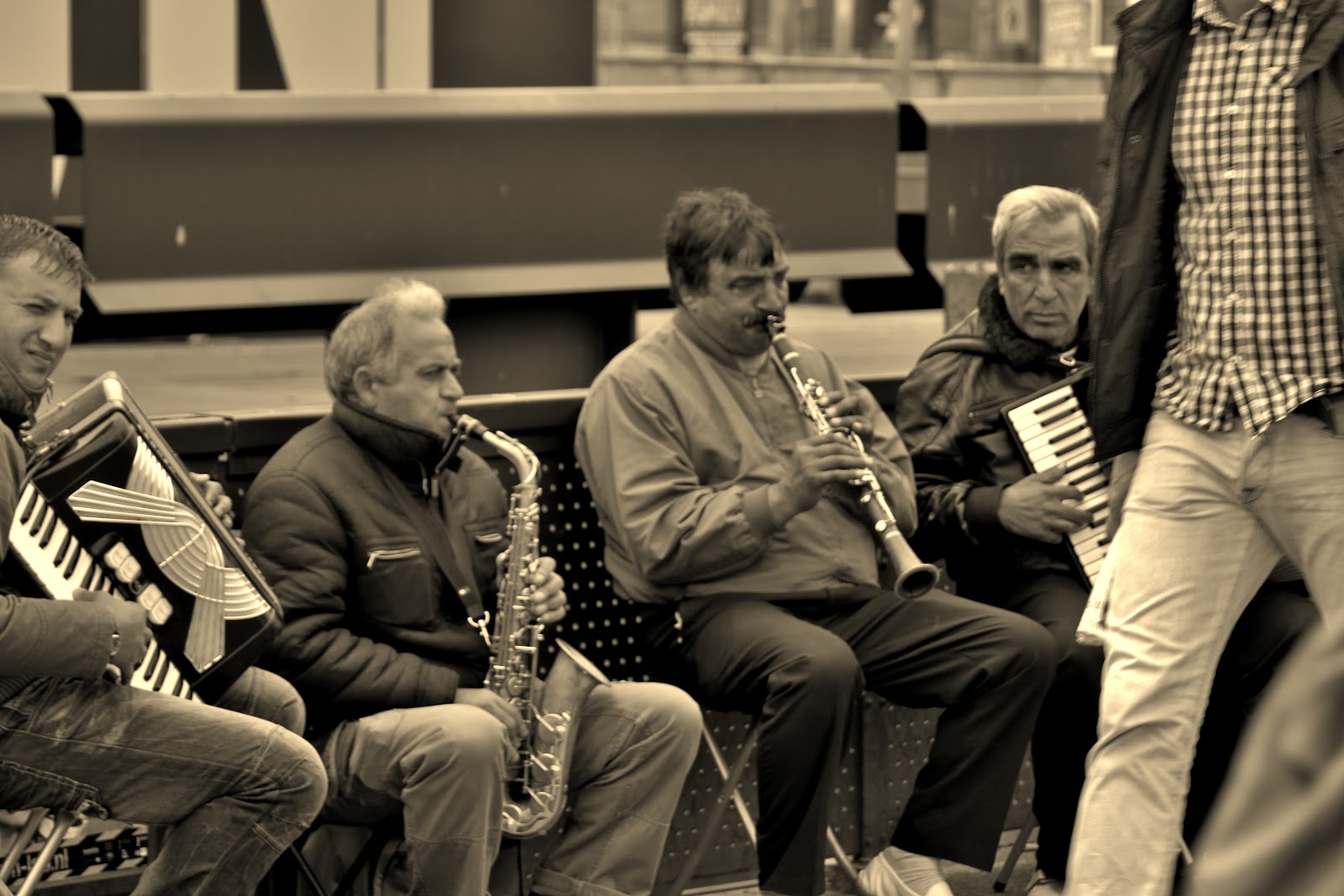
Gypsy Musicians Amsterdam Style!

Well maybe that would be offensive to them if they weren't gypsies, but in fairness, they were going for that whole look to get a bit of shrapnel, so no harm; no foul.

Amsterdam at Centraal, May 2011.

Wednesday, May 25, 2011

Jonathan Sexton: he's our hero.

This week Ireland became a Royalist nation. Everyone is a fan of the Queen and her triumphant State Visit to the country, that was soon to be followed by US President Obama. It took an American, born in Honalulu with a Great Grandfather from Kenya to inspire the Irish to be proud to be Irish. The country was furthermore instilled with pride with the dignified modesty of a very humble but very brilliant Jonathan Sexton, who brought Leinster to an undisputed victory at the Heineken Cup Final. You couldn't have written the script on how that game transpired. Ireland has turned a page. No more will we talk about Bank Bailouts and the IMF. The great nation of craic, pints and banter is back in full swing. Long may it live.

Tuesday, May 17, 2011

I love Berlin! Where East met West.

East Berlin, May 2011.

A sight that would not have been seen a mere 22 years ago. Advertising  and the Western Capitalist world pasted on to the grey and uniform Socialist Architecture of East Berlin...love this City!